Home / Blog / The Rings of a Tree
The Rings of a Tree
On Manikarnika ghat, the age of a tree, and the painting that came out of a night in Banaras.
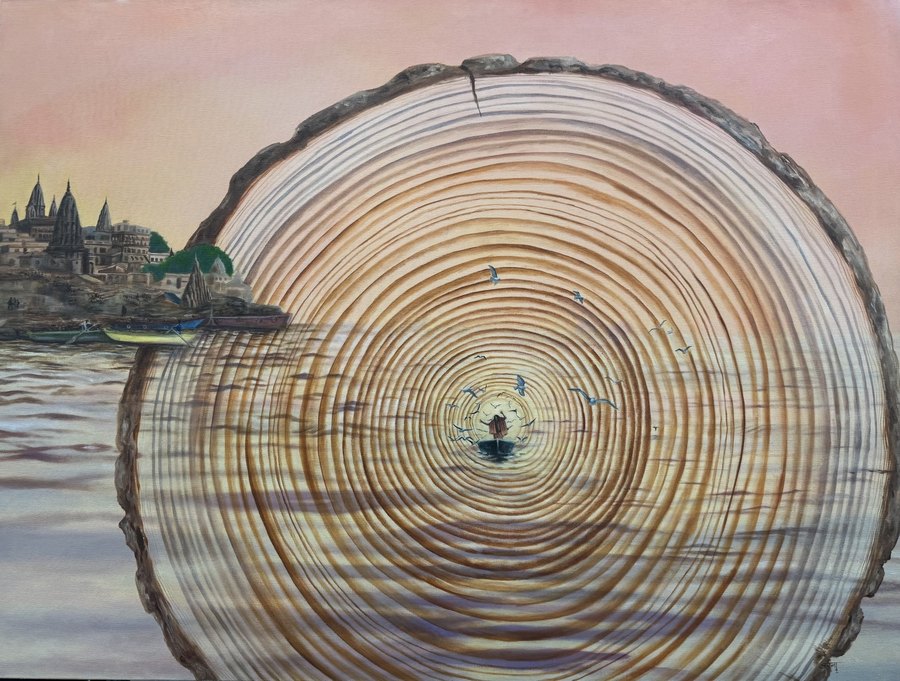
It has been a while since I thought I should write my thoughts down. Not being trained in it made me question myself, and feel underconfident about putting things into words at the same time.
Being a painter made it easier to confess my emotions on the canvas than to say them out loud. But it seems there is an alter ego in me who wants to write these confessions down — so people can understand my visual language better, or, for that matter, because my web designer told me it helps with SEO. Deep down I know I wanted to give my words a chance.
In times when thirty seconds is considered a huge attention span, I know that what I am doing here will at least satisfy my soul, even if it never finds a reader.
It took thirty-eight years on this planet for me to realise that age does not bring people wisdom. It also took me thirty-eight years to come across the fact that a tree's age can be counted by the rings in its trunk. To see those rings, though, it must first be cut. The thickness of each ring tells you whether that year was one of abundance or one of struggle — every ring unique. And to be understood by us, for our research into seasons and weather and whatever else we can take from the planet, it is killed first.
I often choose to travel thinking I might get lucky with some inspiration for a painting or a tattoo, and being that curious wanderer has never disappointed me.
The first hour in Varanasi — Banaras, Kashi — after checking into my hostel, I was desperate to reach Manikarnika ghat. You would ask why. It would be the first time in my life watching people burn after death at a shamshan, a Hindu cremation ground where the dead are burned on a funeral pyre. I was curious to see how I would end, knowing I will never actually be able to watch it, even if I bargained millions with the gods for a live view.
As I reached the ghat I saw the cut tree trunks, their age on display, being ignored — because the self-appointed supreme being on this planet was the show-stopper. The burning and the burnt all stayed quiet, watching the fire take over a life that had gathered all that money, all that ego and fame, only to be burnt to ashes without carrying a single penny out. Except for some tattoos, for the tattooed among us.
That night on the ghat I saw people celebrating life and death at the same time, singing and dancing, not making a big deal of death the way the urban jungles do.
My painting Jatra is a confession to the ultimate journey I watched that night. Everyone understood the dead — but that person had to live, and go through the years of ups and downs, the wonderful memories and the moments that taught them more than any academy could. Just like the tree that witnessed the best and worst of the winds and the weather, completing one ring at a time.
Jatra is about us: put on a boat alone in the middle of a river, distracted by birds and by the many strings we attach ourselves to with each year we live. About our possessions, about the things we own, only to realise that we alone are enough.
We must enjoy the company of these distractions. But we must also acknowledge that we come and go alone, and would do better to sing and dance through all of it — because being able to live at all is reason enough to celebrate, and death might rather be celebrated too, in appreciation of the journey.